


datarooms
Virtual Data Room for M&A in 2026: 15-Document Checklist, Setup, and Pricing
Set up a virtual data room for M&A in 2026. Covers sell-side vs buy-side workflows, the 15-document checklist, folder structure, and top provider comparison.
A due diligence data room is a secure online workspace where companies share confidential documents with investors, buyers, auditors, or partners during a transaction. It provides granular permissions, dynamic watermarking, audit trails, and Q&A workflows so every file stays accounted for across the full diligence cycle (pre-deal preparation, buyer review, negotiations, and close). Papermark offers a due diligence data room at €99/month flat with all security features included.
For the product landing page (setup, pricing, FAQ), see data room for due diligence. For the master document list, see data room checklist 2026.
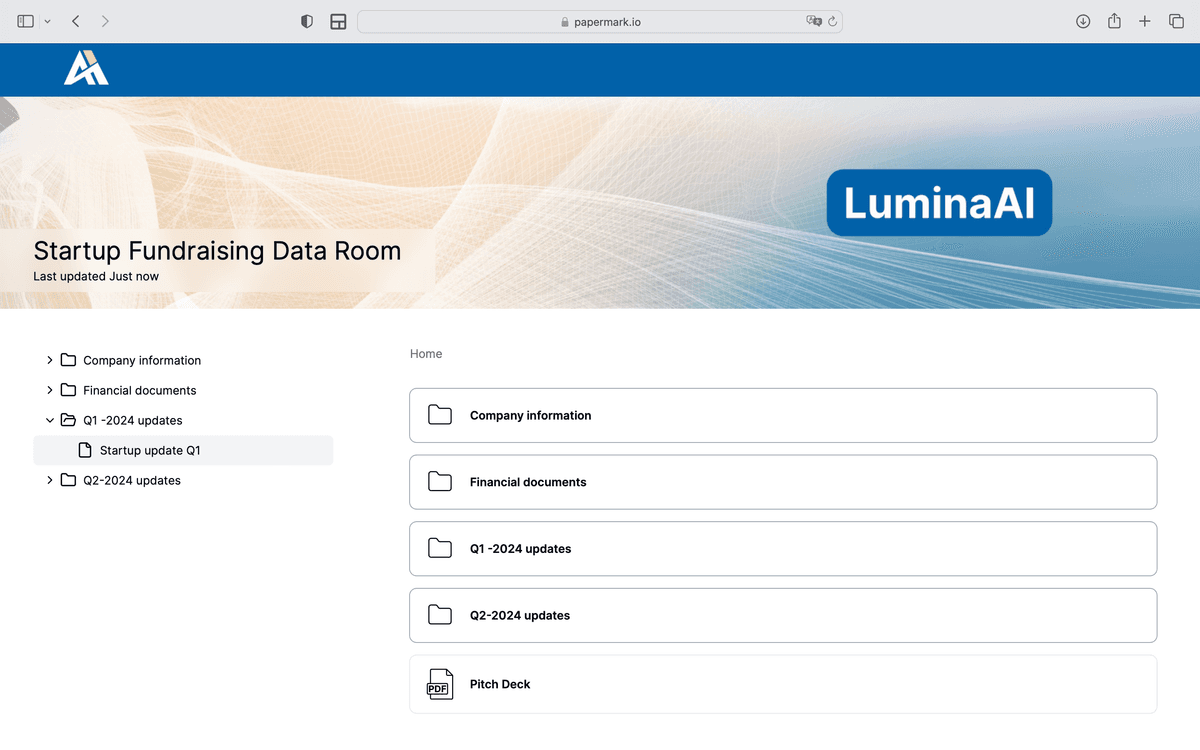
A due diligence data room is a secure online workspace where companies store, organize, and share confidential business documents (financials, contracts, IP records, legal materials) with authorized buyers, investors, or auditors during a transaction. It replaces email attachments and shared drives with granular permissions, dynamic watermarking, and a tamper-proof audit log.
Unlike generic cloud storage, a due diligence data room provides granular access controls, dynamic watermarking, audit trails, and Q&A workflows purpose-built for deal processes. The audit log itself becomes evidence in post-close disputes, which is why M&A counsel and bankers insist on it.
Email attachments and shared drives create real risk when sensitive documents cross organizational boundaries. A dedicated data room solves six problems at once:
Due diligence data rooms come in two forms depending on which party is running the process. The distinction matters because the document strategy, timeline, and permissions model differ significantly.
A sell-side data room is built and populated by the seller (or their banker) before the deal launches. The seller uploads a curated set of documents, structures them by the standard M&A index, enforces NDAs before any viewer sees a file, and scopes separate access links per bidder. This is the dominant model in modern M&A because it gives the seller control over disclosure timing and staged access. Sellers commonly start with a "Stage 1" data room containing the CIM, financial highlights, and top-level corporate documents, then open "Stage 2" folders (detailed financials, customer contracts, IP) only to bidders who pass the first round.
A buy-side data room is maintained by the buyer, with documents uploaded as buyers request them from the seller. This model is more common in acquisitions by strategics reviewing a small company, in vendor or partner diligence, and in corporate development teams running many short parallel evaluations. Buy-side rooms are usually smaller, more iterative, and scoped per acquisition target.
The table below summarizes the difference across the six dimensions that matter when you are setting up a room.
| Dimension | Sell-side data room | Buy-side data room |
|---|---|---|
| Who builds it | Seller or banker | Buyer or corp dev team |
| When | Before deal launch | During buyer review |
| Document volume | High (500-5,000+) | Moderate (100-500) |
| Viewer groups | Multiple bidders, each scoped separately | Usually single buyer team |
| Timing | Structured, multi-stage release | Iterative, request-driven |
| Typical use | M&A auction, Series B+ fundraising, IPO | Strategic acquisition, vendor DD, partner diligence |
For the full M&A workflow, see the M&A due diligence process guide. For structure and folder conventions, see the data room folder structure guide.
Due diligence is not a single process. Data rooms support at least eight distinct types of diligence, each with its own document set, participant mix, and compliance frame.
During M&A transactions, the acquiring company evaluates the target's financial, legal, and operational status. Sell-side advisors typically share thousands of sensitive documents with multiple prospective buyers while maintaining separate access groups per bidder. Granular permissions and dynamic watermarking are non-negotiable.
Investors and lenders assess a company's financial health before committing capital. The data room houses audited financial statements (usually 3-5 years), management accounts, tax returns, cash flow projections, and working capital analyses. Download restrictions and per-session watermarks prevent model exfiltration.
Legal teams review material contracts, litigation records, IP rights, and regulatory compliance. A legal due diligence checklist ensures nothing is missed, and the data room's Q&A module keeps legal questions threaded and auditable. Attorney-client privilege requires careful permissioning.
Evaluating day-to-day operations, processes, supply chain, and customer concentration. Data rooms house operational manuals, quality procedures, vendor agreements, and customer contracts with permission controls that limit visibility to the buyer's operations team.
Assessing IT infrastructure, data privacy posture, security controls, and cyber risk. The data room stores network diagrams, penetration test results, security audit reports, SOC 2 and ISO 27001 certifications, and incident response runbooks. This category of documents requires the highest access controls because exposing them is itself a security incident.
Property transactions require sharing deeds, leases, title reports, zoning documents, environmental assessments, and inspection reports. A real estate due diligence checklist paired with a data room streamlines reviews across multiple properties in portfolio transactions.
Reviewing tax compliance, liabilities, and structure across jurisdictions. The data room organizes tax due diligence documents by jurisdiction and entity for efficient review by tax advisors and buy-side accounting counsel.
Companies evaluate potential vendors and suppliers using vendor due diligence checklists. This is often an ongoing workflow (not a single transaction), so the data room operates as a permanent vendor-review portal rather than a deal-specific room.
A well-prepared due diligence data room covers eight document categories. The table below lists the essential and nice-to-have documents you should include, with the specifics confirmed by your legal and financial advisors based on your transaction type and industry.
| Document | Category | Essential | Nice to Have |
|---|---|---|---|
| Corporate Structure Chart | Corporate Information | ||
| Certificate of Incorporation | Corporate Information | ||
| Bylaws and Amendments | Corporate Information | ||
| Shareholder Agreements | Corporate Information | ||
| Board Meeting Minutes | Corporate Governance | ||
| Audited Financial Statements (3-5 years) | Financial Information | ||
| Management Accounts | Financial Information | ||
| Cash Flow Projections | Financial Information | ||
| Tax Returns (3-5 years) | Financial Information | ||
| Material Contracts | Legal Documents | ||
| Customer Contracts | Legal Documents | ||
| Supplier Agreements | Legal Documents | ||
| Employment Agreements | Human Resources | ||
| Employee Handbook | Human Resources | ||
| Organizational Chart | Human Resources | ||
| Intellectual Property Portfolio | IP and Technology | ||
| Patent Applications/Registrations | IP and Technology | ||
| Trademark Registrations | IP and Technology | ||
| IT Systems Overview | IP and Technology | ||
| Real Estate Deeds/Leases | Assets | ||
| Equipment Leases | Assets | ||
| Insurance Policies | Risk Management | ||
| Litigation History/Current Lawsuits | Legal Documents | ||
| Regulatory Filings | Regulatory Compliance | ||
| Permits and Licenses | Regulatory Compliance | ||
| Environmental Compliance Reports | Regulatory Compliance | ||
| Business Plan | Strategic Documents | ||
| Market Analysis Reports | Strategic Documents | ||
| Customer Lists and Data | Sales and Marketing | ||
| Product/Service Descriptions | Operations | ||
| Quality Control Procedures | Operations |
For more detailed checklists by type, see the M&A due diligence checklist, legal due diligence checklist, and investment due diligence checklist.
Due diligence is not a single-pass review. Documents are released in waves that align with the deal phases. The table below maps the four phases of a typical M&A due diligence cycle (roughly 4-8 weeks total) to the documents that need to be ready at each phase.
| Phase | Timing | Documents needed | Typical activity |
|---|---|---|---|
| 1. Pre-launch prep | Weeks -4 to 0 | CIM, teaser, top-level corporate docs, audited financials | Sell-side banker assembles and reviews the room |
| 2. Initial buyer review | Weeks 1-2 | Corporate structure, financials, material contracts, top customers | Stage-1 bidders access data, submit initial IOIs |
| 3. Deep diligence | Weeks 3-5 | Full legal binders, IP portfolio, HR contracts, tax returns, operational detail | Short-list bidders submit Q&A, request management meetings |
| 4. Confirmatory and close | Weeks 6-8 | Updated financials, regulatory confirmations, final contracts | Final bidder completes confirmatory DD, signs SPA |
Document-request peaks at weeks 2-3, which is also when page-by-page analytics become most valuable. A bidder who opens the financial model three times in week 2, then re-opens the customer contracts folder in week 3, is signaling active interest. A bidder who stops engaging by week 3 usually will not re-enter the process. That is the kind of signal the VDR's audit log surfaces in real time.
See how G.P. Loree & Co., a New York-based family office, uses Papermark to organize institutional investment data and run due diligence on multiple concurrent investments:
Setting up the room correctly saves time and reduces friction throughout the deal. Watch the video walkthrough below, then follow the written steps.
Security in a due diligence data room is non-negotiable. Every serious VDR in 2026 ships the eight controls below as standard. If a provider is missing any of them, it is not ready for a regulated deal.
See Papermark's link settings documentation for the full security configuration options.
For organizations with strict data sovereignty requirements (healthcare, financial services, government contractors, biotech under HIPAA), Papermark offers a self-hostable open-source deployment. The self-hosted version ships the full feature set (granular permissions, dynamic watermarking, page-by-page analytics, Q&A module, custom domains) on your own infrastructure.
Papermark offers transparent flat-rate pricing: €99/month for the Data Rooms plan, with a 7-day free trial. Compared to legacy VDR providers at €750+/month (iDeals, Firmex, DealRoom) or $25,000+/year (Datasite, Intralinks), Papermark removes the per-page billing that inflates traditional enterprise quotes.
The Data Rooms plan (€99/month) includes 3 team members, unlimited data rooms and documents, custom domain for data rooms, dynamic watermarking, NDA agreements, granular file-level permissions, Data Room groups, and dataroom analytics. The Data Rooms Plus plan (€249/month, 5 team members) adds audit log for visitors, Q&A module with permissions, automatic file indexing, dedicated account manager, and SOC 2 Type II. See Papermark Data Rooms pricing for the full plan comparison.
Set up a virtual data room for M&A in 2026. Covers sell-side vs buy-side workflows, the 15-document checklist, folder structure, and top provider comparison.

How investment banks run data rooms in 2026 - teaser, CIM, bidder outreach, diligence, and close. Document checklist, IB workflow, and provider comparison.
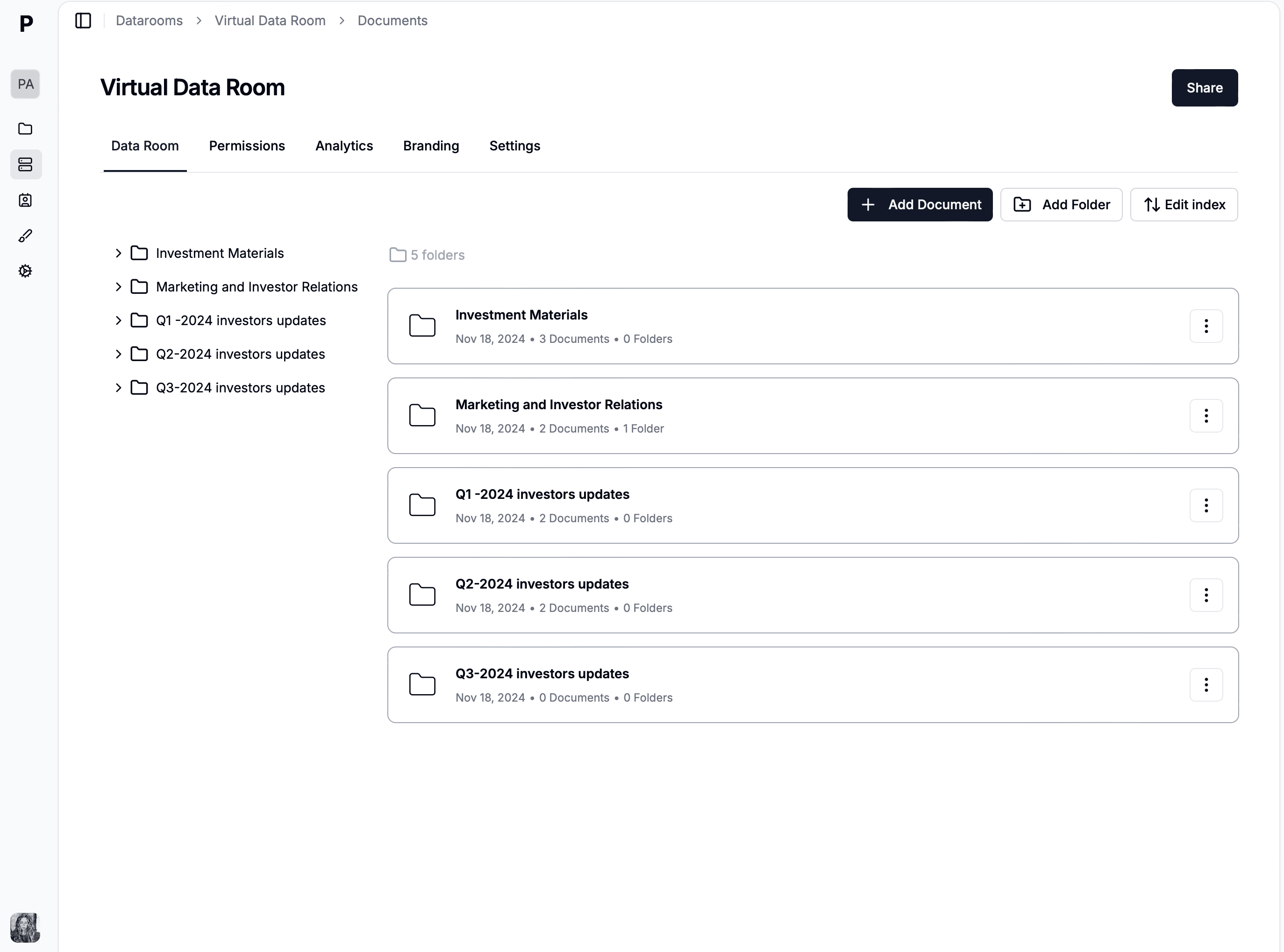
How to set up an IPO data room in 2026 from €99/month. S-1 readiness, SEC and underwriter documents, EU prospectus requirements, pre-IPO vs IPO execution, and pricing compared.